I don’t know about you, but when I want a beer, I almost always go for a microbrew. Not only do they taste better to me, not only am I supporting a small business, but because craft brewers are free to experiment with a diversity of flavors, they’re far more likely to create my favorites.
Now, I’m not here to rail against the popular mass-produced breweries, and I’ll even drink one if it’s the best option around. While it may not always suit my particular palette, at least I know what I’m getting.
I feel the same way about horror fiction. While over the decades I’ve enjoyed authors whose books have been published by large mainstream publishing houses, my favorites these days tend to come from small and indie presses.
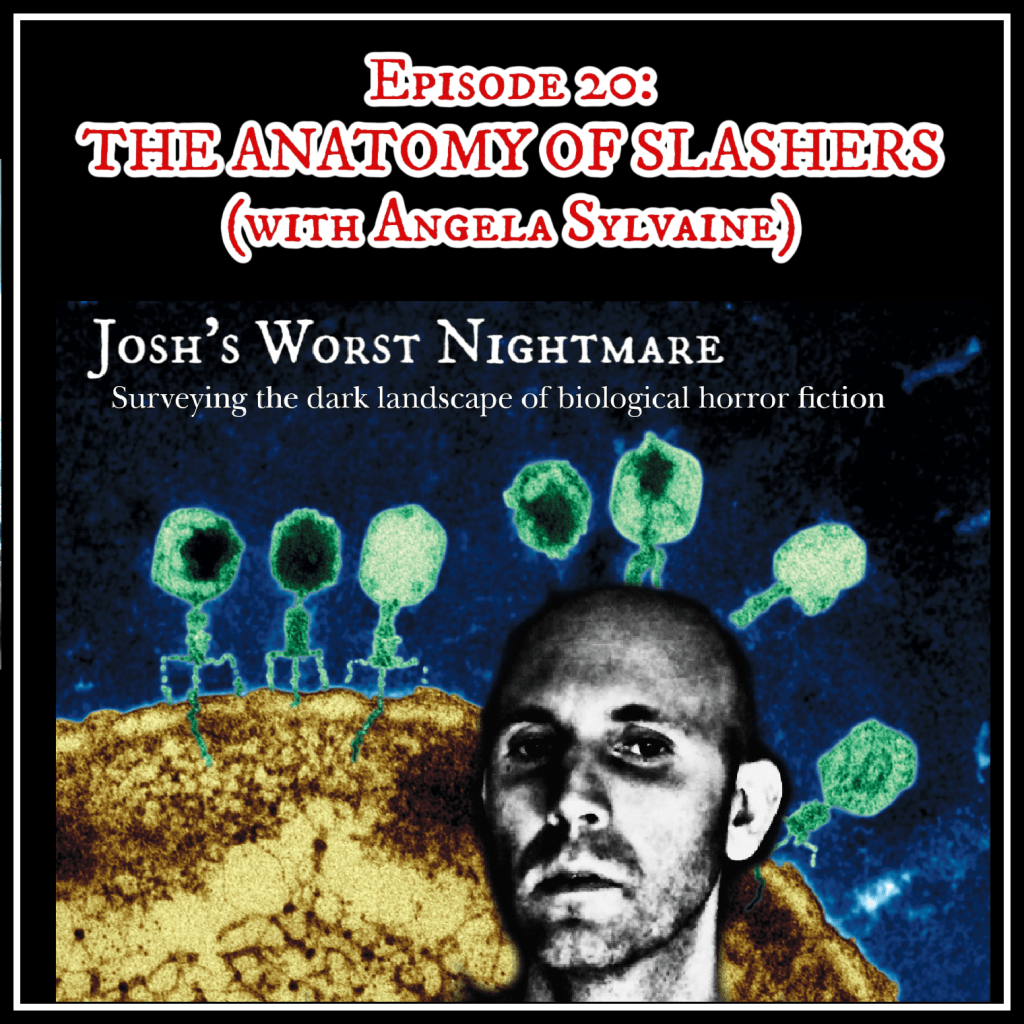
Some folks may wonder how I choose guests for my obscure podcast, Josh’s Worst Nightmare, where I, benighted author Josh Schlossberg, survey the dark landscape of biological horror.
Truth be told, there’s an arcane ritual with a rabid fox’s saliva, stingers from a hundred wasps, and the first spring growth of an ancient mountain spruce. But that’s all just to silence the demons in my head. My real decision-making process is a lot simpler: I invite on the writers I see uplifting others in the indie horror community.
I was able to trick the esteemed publication, Shoutout Colorado, into thinking I’m a successful author, editor, and publisher. Read all my dirty lies below.
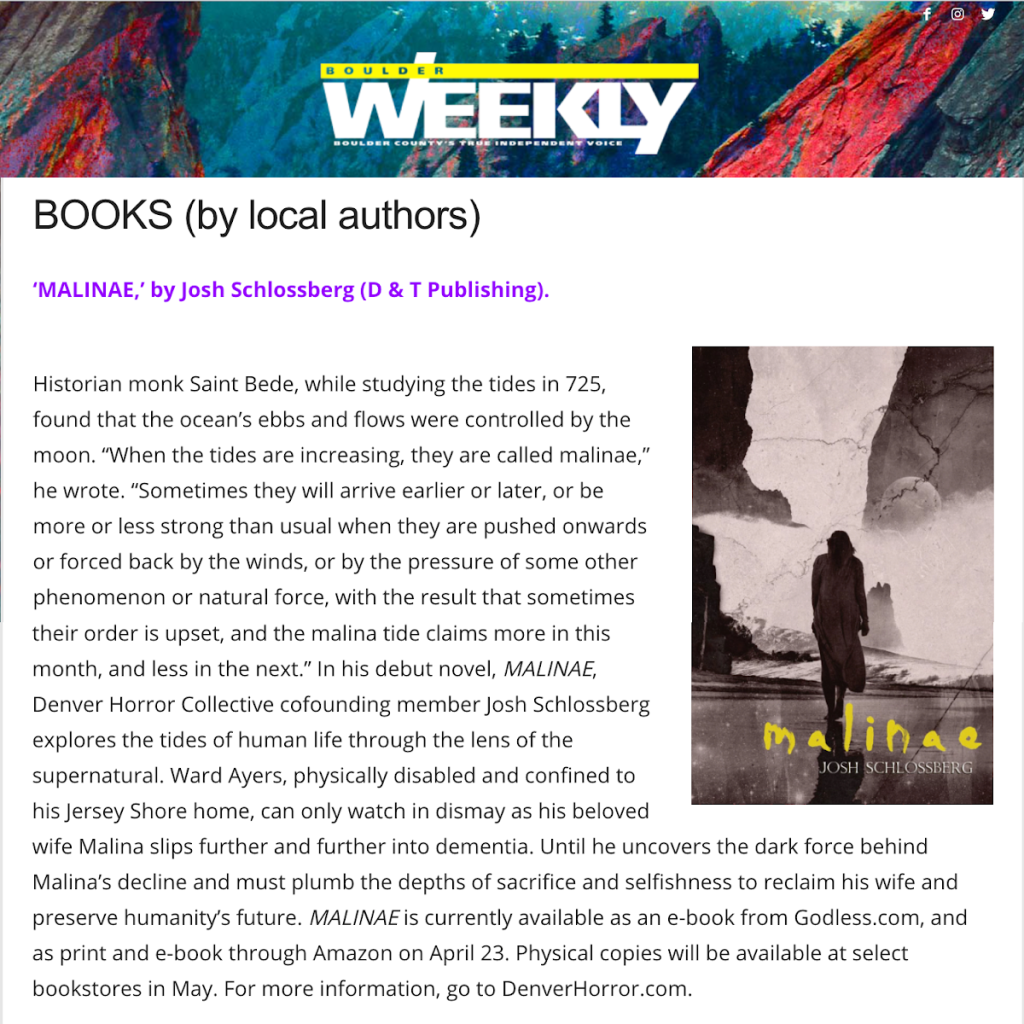
MALINAE, my cosmic folk horror novella from D&T Publishing, and THE JEWISH BOOK OF HORROR, the anthology I edited for Denver Horror Collective, together at last in Denver Westword! (even if it was several weeks ago)
On episode #21 of Josh’s Worst Nightmare, host Josh Schlossberg gets visceral with Angela Sylvaine, author of CHOPPING SPREE, to dissect the anatomy of slasher horror.
On Monday, October 4 @ 5 pm PT / 6 MT / 7 CT / 8 ET, tune in to the Denver Horror Collective YouTube channel to check out the premiere of the trailer for THE JEWISH BOOK OF HORROR, the horror fiction anthology I’m editing for Denver Horror Collective!
“What else is new?” some of you might be asking. In that case: It’s turning me into MORE of one!
Here’s why: It’s the only way to get my shit out there. Allow me to explain.
I happen to have been blessed with an excellent and generous publisher, D&T Publishing. Despite being a small press, D&T has done more to promote my debut cosmic folk horror novella, MALINAE, than the “Big Four” presses do for most of their authors. For that I am eternally grateful and, indeed, it’s the main reason the book has gotten out there as much as it already has, which is quite a bit.
However, in the sales world, we all know that a tiny percentage of products get the vast majority of buys. Take Coca Cola for instance, which snags half of the soda sales in the U.S. Is Coke really the best carbonated sugar water in the country? Not even close (not counting its cocaine-laced days, of course)! Hell, I’ve probably drank fifty different small batch colas better tasting and less horrible for you than Coke. But you’ve only heard of a few of them, and barely, at that. Because it’s not just about the product—which does have to be adequate—it’s about the marketing.
Let’s take this into the horror world. Stephen King alone gets the vast majority of horror fiction reads. Now, before going any further, I’m not here to shit on “the King.” I cut my literary teeth on the man and found him formative in my teens. Today, I still enjoy many of his stories and novels and think he’s a formidable storyteller.
But is he the best horror author in the world, the way sales suggest? Not even close! Hell, I’ve probably read at least fifty horror authors who are better writers and storytellers than him. But you’ve only heard of a few of them, and barely, at that. Because it’s not just about the product—which does have to be adequate—it’s about the marketing.
So what’s my point? That people should stop drinking Coke and reading King?
Of course not. Simply that the playing field is far from level, and we authors don’t have the luxury of simply writing good books and expecting them to fly magically into the hands of readers.
On episode #11 of Josh’s Worst Nightmare, host Josh Schlossberg gets out the literary scalpel with Hollie & Henry Snider, editors of CONSUMED: TALES INSPIRED BY THE WENDIGO, to biopsy cancer.
I blackmailed Westword, Denver’s alt-weekly, to write a piece about me, and they fell right in line.
It wasn’t the pandemic that provided the inspiration for Denver horror author Josh Schlossberg’s new novel, Malinae, a yarn of biological horror about growing old…and perhaps growing in terrifying ways, too. But the pandemic did provide the time in which he could write it.
“The book’s biggest overlap with the pandemic is the isolation the protagonist experiences, cooped up in his house thanks to a severe case of rheumatoid arthritis and unable to participate in the activities he used to take for granted. And, as many of us have learned over the coronapocalypse, the long-term effect of isolation is an increasing alienation with humanity as a whole,” Schlossberg says. “Or maybe that’s just me.”




 Josh's Worst Nightmare